UNDERSTANDING THE PROPHETIC MINISTRY.
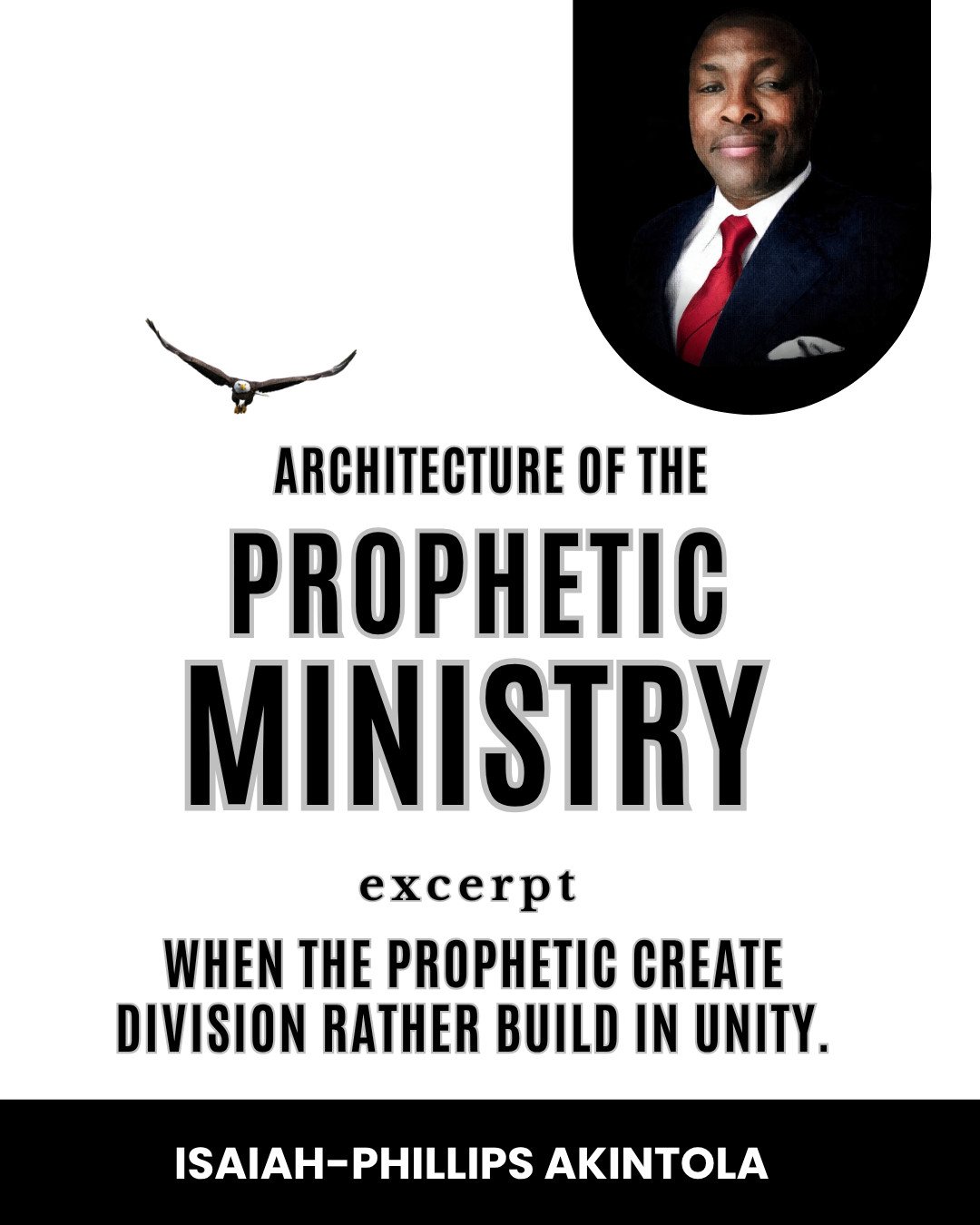
WHEN THE PROPHETIC CREATE DIVISION RATHER BUILD IN UNITY.
As part of my ongoing work about understanding prophetic architecture and the prophetic ministry, I have been sharing some excerpts from my latest book that should further give insight into what the Father is revealing in at this critical season we find ourselves. Of course, one of the instruments the Lord has given to us to make sense of times and seasons is the prophetic office. However, there’s been a lot of confusion and misunderstanding which is strategic in derailing heaven’s intention.
In this excerpt, I’ll like to emphasis the point that the prophetic ministry is not restricted to spoken words or forecasts concerning the future. Instead, it embodies a spiritual lifestyle reality, condition of thinking, one that operates as a multidimensional system rooted in heavenly realities and concealed within Christ. This ministry does more than communicate messages; it establishes an atmosphere and a governing presence wherever it functions. Through its operation, the prophetic reveals the sovereign character and authority of God within a particular environment or sphere, demonstrating His rule and influence in a tangible manner.
Wherever the prophetic operates, the rule and government of heaven does not simply influence circumstances, it presides over them. The prophetic function serves as the leading voice God deploys to establish His mind and reign within human affairs, particularly in relation to His ongoing redemptive and reformative purposes. The prophetic ministry is proactive, shaping history according to the pattern set in the counsel of heaven before time began, rather than merely reacting to events.
A prophet, therefore, is the embodiment of heavenly leadership order on earth, the prophet’s assignment is threefold: to establish, maintain, and advance the agenda of Jesus Christ, ultimately working toward the restoration of all things to their original, ordained place. This purpose is clearly defined in Ephesians 1:10, which speaks of summing up all things in Christ, both in heaven and on earth.
The prophet exists within this divine trajectory, every word spoken, every assignment undertaken, and every confrontation engaged is directed toward fulfilling this single, overarching intention. Where the Spirit of the Lord moves through the prophetic presence, liberty follows, as Paul states in 2 Corinthians 3:17, “Where the Spirit of the Lord is, there is liberty.”
This liberty is not license or freedom to do as one pleases, instead, it is the release that comes from submitting to the influence, guidance, and leading of the Spirit of the Lord. Genuine freedom is produced through submission to the Spirit, who leads individuals out of bondage and into the purposes for which they were created. Jesus further expatiated on this spiritual presence in Luke 4:18 when he declared that the Spirit of the Lord was upon him because he had been anointed. That anointing was the source of everything that followed: sight restored to the blind, freedom proclaimed to the captive, deliverance announced to the oppressed. The anointing does not merely announce liberty, it produces it. It gives people the advantage knowledge, skill and insight to see what they could not formally see and to walk in what God has already empowered them to do.
The prophetic carries that same anointing into every space it enters. It does not leave people where it finds them. The prophet carries the blueprint of heaven’s architectural design, but the role goes beyond knowing what God intends to build. The prophet is also the custodian of the authority and power required to build it. This authority flows from a sustained relationship with the One whose design it is. Jeremiah received the word before he was formed in the womb, and with it came the appointment to nations, to root out and pull down, to build and to plant (Jeremiah 1:5, 10). As we can see, the blueprint and the builder’s mandate arrived together.
The heart of a true prophet is oriented first toward the Father. His deepest burden is not to perform a function but to bring pleasure to God through the way he lives. The lifestyle of a prophet itself is a profound prophetic statement. Before the words come the walk, and the walk declares what the words will confirm. This is why the prophet’s private life cannot be separated from the public office. The integrity of the one validates the weight of the other.
John 1:14 The Word became flesh and made His dwelling among us. We have seen His glory, the glory of the one and only Son from the Father, full of grace and truth.
The prophetic gift and its functions are not isolated spiritual phenomena. They are the direct manifestation of the outpouring of the Spirit that Joel described in chapter 2 and that Peter declared was being fulfilled on the day of Pentecost in Acts 2. When people prophesy, move in words of knowledge, or demonstrate discernment, this is not the exclusive preserve of a spiritual elite. It is the natural fruit of a Spirit-saturated community. The church should not be surprised by it, nor should it treat it as something strange or elevated beyond ordinary reach.
“And it shall come to pass afterward, that I will pour out my Spirit on all flesh; your sons and your daughters shall prophesy…” (Joel 2:28, ESV)
The scripture is equally clear that we are moving toward a greater outpouring as the age advances. Prophesying, words of knowledge, words of wisdom, and discernment will not decrease as history presses toward its finality. They will intensify. The saints should be positioned for that reality, not confused or intimidated by it. Moses made a statement that most spiritual leaders would be reluctant to make today. He said it was his desire that all of God’s people would prophesy, without exception (Numbers 11:29). Moses understood that the Spirit of God moving through ordinary people was not a threat to order; it was the design of heaven.
The Confusion Around the Prophetic
There has been considerable confusion, misleading information, and misgivings within the body of Christ regarding what is commonly known as the prophetic office and its various spiritual gifts. This confusion is not simply the result of a lack of knowledge or understanding. Instead, it is rooted in a deliberately distorted perception that emphasizes powerful religious performances, often masquerading as authentic biblical spirituality.
In many cases, the prophetic ministry has been redefined and presented as a spiritist influence, wielded at the discretion of those who are perceived to possess the power to summon spiritual forces to fulfill their own desires. This distortion allows certain individuals to gain influence, authority, and prominent positions among members of the Body of Christ. Sadly, this has fostered a false sense of superiority within ministry ranks, undermining the true purpose of prophetic ministry.
This misrepresentation is intentional and orchestrated by the works of darkness, aiming to corrupt and pollute the wellspring of genuine prophetic gift and its function. The enemy has employed this strategy repeatedly, and the church in Corinth stands as a clear biblical example of how such confusion can infiltrate and disrupt the unity and effectiveness of the prophetic ministry within the church.
In Paul’s first letter to the Corinthians, he addresses a fundamental issue that undermined the unity of the congregation. The church had splintered into four distinct factions, each group identifying with a particular leader as their spiritual banner. One group claimed, “I follow Paul,” another declared, “I follow Apollos,” while a third rallied around Cephas. The fourth group, perhaps the most spiritually self-assured, asserted, “I follow Christ,” as if this allegiance elevated them above the others (1 Corinthians 1:12). What appeared to be mere theological preference was, in reality, an expression of fleshly attitudes within the Christian community. The names of ministers and even the name of Christ himself were being used to justify division, revealing the underlying problem of misplaced loyalties.
“For it has been reported to me by Chloe’s people that there is quarreling among you, my brothers. What I mean is that each one of you says, ‘I follow Paul,’ or ‘I follow Apollos,’ or ‘I follow Cephas,’ or ‘I follow Christ.’” (1 Corinthians 1:11-12, ESV)
Paul’s response was not to defend his own ministry or diminish Apollos and Peter. He dismantled the entire religious thinking of the Church. He wrote that he and Apollos were simply servants through whom the Corinthians had believed, each doing the work the Lord assigned (1 Corinthians 3:5). He called them fellow workers in God’s field, not competitors for God’s favour. The field belonged to God. The building belonged to God. The ministers were instruments in His hand, not personalities to be ranked or followed as substitutes for Christ.
“What then is Apollos? What is Paul? Servants through whom you believed, as the Lord assigned to each.” (1 Corinthians 3:5, ESV)
Paul revealed a deeper problem within the Corinthian church: their perspective on prophetic gifts was shaped by carnal thinking. Instead of viewing spiritual gifts through the lens of God’s purpose, they applied humanistic marketplace logic, assigning value based on qualities such as gifts, eloquence, influence, and the ability to attract followers. For example, Apollos was recognized as a skilled speaker, while Paul openly acknowledged that his own speech was not nearly as impressive (2 Corinthians 10:10). Yet, rather than competing in rhetoric or adjusting his ministry to gain popularity, Paul remained steadfast in preaching Christ crucified. He intentionally avoided persuasive wisdom that might undermine the message of the cross (1 Corinthians 1:17).
What Prophecy Actually Is
Much of the confusion rests on a misidentification of what prophecy is and what it requires. Many have come to believe that the ability to prophesy signals special anointing or exclusive spiritual capacity. That belief needs to be corrected squarely and with scriptural grounding.
Every child of God who carries the Spirit of God has access to prophetic expression. Prophecy, at its foundational level, is the gift of utterance that allows a believer to encourage, edify, and give insight into the heart and mind of God toward others. Paul writes in 1 Corinthians 14:3 that prophecy speaks to people for their upbuilding, encouragement, and consolation. It is a gift given for the benefit of the body, not for the elevation of the one through whom it flows.
“On the other hand, the one who prophesies speaks to people for their upbuilding and encouragement and consolation.” (1 Corinthians 14:3, ESV)
When we understand that prophecy as a gift of utterance exists to develop and edify the body of Christ, the idea of treating it as an exclusive office reserved for the specially gifted loses its footing. The gift is given freely. The Spirit distributes as He wills, and His intent is not to concentrate power in a few but to build up the many.
The Prophetic Gift and the Prophetic Office Are Not the Same
This is perhaps the most critical distinction this book will make. The fact that someone prophesies, demonstrates prophetic values, or expresses prophetic insight does not automatically constitute them a prophet. These are not the same thing, and the failure to distinguish between them has caused enormous confusion, premature ministry office positioning with potential of creating greater harm to the Body of Christ.
Moving in the gift of prophecy is not the same as holding the prophetic office. A person may consistently encourage the body through some kind of prophetic gift and utterance and may never be called to the office of the prophet. Conversely, the prophet carries a governmental function in the body of Christ that extends well beyond the act of prophesying. The office involves a consistent, sustained, and specifically commissioned role in revelation, intercession, confrontation, and the building of spiritual foundations and kingdom governmental structures.
My intention, therefore, through this book and training material is to biblically lay a solid spiritual footing that enhances and solidifies our spiritual development and journey towards that perfect day in Christ. To make this objective a reality, we must upgrade and update the various components of our spiritual identity, value systems, and frameworks of approach. Luke 1:80 provides a profound example of this developmental principle: “And the child grew, and waxed strong in spirit, and was in the deserts till the day of his shewing unto Israel.” John the Baptist’s development reveals four critical phases: physical growth, spiritual strengthening, hidden preparation in the wilderness, and finally, public manifestation at the appointed time.
Discover more from PortalsGate
Subscribe to get the latest posts sent to your email.