IS THERE NOT A MAN WE CAN INQUIRE FROM?
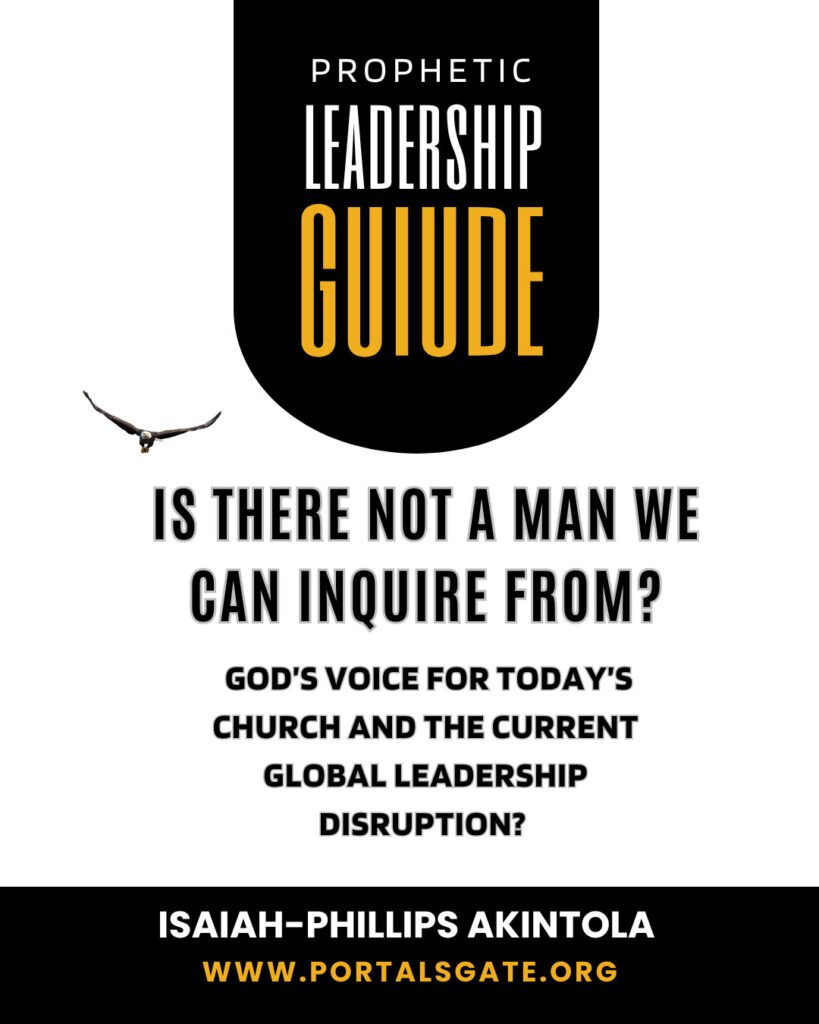
WHAT IS GOD’S VOICE FOR TODAY’S CHURCH AND THE CURRENT GLOBAL LEADERSHIP DISRUPTION?
So the king of Israel assembled the prophets, about four hundred men, and asked them, “Should I go to war against Ramoth-gilead, or should I refrain?” “Go up,” they replied, “and the Lord will deliver it into the hand of the king.” But Jehoshaphat asked, “Is there not still a prophet of the Lord here of whom we can inquire?” The king of Israel answered, “There is still one man who can ask the Lord, but I hate him because he never prophesies anything good for me, but only bad. He is Micaiah son of Imlah.” “The king should not say that!” Jehoshaphat replied.
2 Kings 22:6-8 (NIV)
THE CORRUPTION OF A PROPHETIC ORDER
Jehoshaphat’s question carries more weight than a simple request. It is a diagnosis. Four hundred prophets had gathered before two kings, and every one of them had spoken with confidence, all pointing in the same direction, all with the same word: go to war, the Lord is with you. Yet something in Jehoshaphat would not settle. He had the ear of every prophetic voice in the land, but he did not have the word of God. So he asked: is there not still a prophet of the Lord of whom we can inquire?
That question is a verdict on four hundred men. It exposes the degree to which an entire prophetic institution had been compromised, not by silence, but by speech. These were not men who refused to prophesy. They prophesied freely, enthusiastically, and at great length. The damage was done precisely through their words, because those words were aligned to a throne rather than to God. Israel’s prophetic company had drifted from the table of the Lord to the table of Jezebel, and that shift was not merely personal. It reshaped the national trajectory of a people.
When the prophetic voice of a nation loses its independence from power, it does not become irrelevant. It becomes dangerous. The four hundred still functioned in the ritual of prophecy, still gathered before the king, still spoke in the name of the Lord. The form remained; the substance had evacuated. That is the condition Jehoshaphat discerned, and it prompted him to keep asking until he found something different.
MICAIAH AND THE PATTERN OF THE TRUE PROPHETIC VOICE
Micaiah son of Imlah did not have the platform. He did not sit in the proximity of power that the four hundred occupied. Ahab’s summary of him was blunt: he never prophesies anything good for me, only bad. That assessment tells us everything we need to know about the difference between the two kinds of prophetic voice. The four hundred prophesied what the king wanted to hear. Micaiah prophesied what God wanted said. Ahab interpreted Micaiah’s consistency as personal antagonism. The truth was simpler: Micaiah had never substituted the king’s preferences for the mind of God.
Jehoshaphat’s response to Ahab’s description is instructive: “The king should not say that.” He was not defending Micaiah’s reputation. He was correcting a posture toward the prophetic voice. A leader who preemptively frames a prophet as an enemy because that prophet refuses to affirm the leader’s existing plans has already closed the very channel through which God speaks direction and protection. Ahab had not silenced Micaiah; he had simply stopped listening to him. That selective deafness would cost him his life at Ramoth-gilead.
The Micaiah pattern still walks among us. The true prophetic voice rarely occupies the most prominent seat in the room. It tends to carry a message that inconveniences the powerful, challenges the consensus, and refuses to bend itself toward whoever controls the resources. That is not negativity. That is the nature of a voice that has been formed in the presence of God rather than in the culture of the court.
INQUIRY AS A GOVERNING PRINCIPLE
In ancient Israel, the protocol before war was not strategic assessment alone. Godly kings sought the word of the Lord before committing the nation to any major initiative. That was not religious formality; it was a recognition that human intelligence operates within limits that divine intelligence does not share. The battlefield outcome was determined in the spirit before the armies moved on the ground.
Jehoshaphat carried this conviction through his entire reign. After the death of Ahab, his son Jehoram came to power. When Jehoram wanted to move against the king of Moab who had rebelled against Israelite authority, the same pattern asserted itself. Jehoshaphat’s first question was not about military strength or strategic positioning. He asked: is there not a prophet of the Lord here, through whom we may inquire of the Lord? (2 Kings 3:11, NIV). Elisha, son of Shaphat, the man who poured water on the hands of Elijah, was identified as the answer.
What stands out in both accounts is that true prophets were present in the land. They were not absent. They were neglected. The prophetic infrastructure that Israel needed to navigate national crisis existed; it had simply been bypassed in favor of voices that accommodated existing agendas. Jehoshaphat’s repeated question was not searching for someone new. It was searching for someone genuine in a landscape saturated with something that looked prophetic but was not.
The principle of inquiry has never been confined to a particular era. Spiritual realities do not operate within time boundaries, and the necessity of seeking God’s direction before engaging significant initiatives belongs to every generation. What changes is the form; the requirement does not. A leader who moves without the mind of God moves with the authority of their own understanding alone, and human understanding, however sophisticated, cannot see what God already knows.
THE GENEALOGY OF THE PROPHETIC ANOINTING
Elisha’s identification in 2 Kings 3:11 carries a detail that deserves attention: he was the one who poured water on the hands of Elijah. That description is not incidental. It establishes the lineage of his prophetic formation. The anointing Elisha carried was traceable, not because it passed through spiritual genetics alone, but because the values, integrity, discipline, and commitment that defined Elijah’s prophetic ministry were the same ones Elisha had absorbed through years of proximity and service.
Prophetic connection is not neutral. Whoever forms you defines what flows through you. A prophetic voice shaped by access to power rather than access to God will ultimately prophesy toward power rather than toward truth. A prophetic voice formed through genuine surrender to the fear of God, through the discipline of waiting, through the willingness to carry a word that is not popular, will release something substantially different into the atmosphere of a community or a nation. The Elijah-Elisha connection demonstrates that the authenticity of a prophetic stream is always upstream from the individual who carries it.
This matters enormously for how prophetic ministry is assessed today. The anointing is not the only indicator of prophetic integrity. The character of the source matters. The value system embedded in the formation matters. The willingness to carry inconvenient truth into comfortable rooms matters. When prophetic voices compromise those foundations, what they release into society takes on the shape of what formed them, and the people who receive that word mistake the form of prophecy for the substance of it.
SPIRITUAL GOVERNANCE AND NATIONAL AFFAIRS
The ancients understood something that modern secular governance has largely suppressed: decisions made at the level of nations carry a spiritual dimension that human analysis alone cannot fully navigate. Ungodly kings consulted omens, diviners, and familiar spirits before going to war. Godly kings sought the word of the Lord through his prophets. Both sets of kings were operating on the same foundational assumption: that outcomes in the natural realm have their origins in the spiritual realm, and that spiritual intelligence must precede natural strategy.
The same dynamic operates today. Political alignments, economic policies, bilateral engagements, and governance decisions are not purely technical matters. Behind every significant institutional movement, there is a spiritual architecture being built. The question is always which spiritual influence is doing the building. Board rooms and legislative chambers are not spiritually neutral environments. Decisions made in those spaces carry the imprint of whatever spiritual allegiance the decision-makers have, whether they acknowledge it or not.
The prophetic figures surrounding political leadership carry significant responsibility in this regard. When spiritual advisors to those in authority have themselves drifted toward affirmation rather than accuracy, the results manifest at the level of policy, conflict, and national trajectory. Decisions that are celebrated in the moment as bold or visionary can expose, over time, the absence of genuine prophetic input. The outcomes tell the story that the surrounding voices did not tell the leader before the decision was made.
The church must recover its clarity on this point. Prophetic ministry was never designed primarily for personal edification cycles. God commissioned Jeremiah to stand over nations and kingdoms, to uproot and plant, to destroy and to build (Jeremiah 1:10, NIV). That is governmental language. The prophetic voice was designed to operate at the level of national direction and societal formation. When the church confines the prophetic to the interior of its own programmes and community-level encouragement, it abandons a governmental authority that God placed in prophetic ministry for the ordering of societies.
THE LAST-DAYS CONTEXT AND THE URGENCY OF THE QUESTION
The convergence of forces working to reshape global identity, governance structures, and human consciousness is not happening in a spiritual vacuum. Scripture already described these movements. The construction of systems that concentrate authority, diminish individual dignity, and position a single governing intelligence over human society has a name in prophetic scripture, and its culmination is the emergence of the man of lawlessness, who will take his seat in the temple of God and declare himself God (2 Thessalonians 2:4, NIV). The church is watching these structures assemble in real time and asking what its role is in this moment.
The answer has not changed from Jehoshaphat’s era to ours. God has positioned prophetic men and women across nations, within spheres of influence, in proximity to institutions, carrying a word that the four hundred voices around those institutions will not speak. They may be less visible. They may not hold the ministry credentials that carry immediate cultural authority. They may be, like Micaiah, identified by the powerful as voices that never say what the powerful want to hear. They carry the word of the Lord precisely because they have refused to trade it for access.
The church cannot afford to continue functioning as an organisation that manages religious activity while the governance of nations moves in directions that prepare the ground for spiritual totalitarianism. God empowered the church to be a prophetic voice with the presence and authority to establish his kingdom on earth. That mandate does not recede in the face of cultural resistance or institutional irrelevance. It intensifies. The question Jehoshaphat asked in the courts of Ahab is the question that must be asked again now, not as a nostalgia for ancient forms, but as a recovery of the governing function that the prophetic was always meant to carry.