LEADERSHIP AND NATION BUILDERS.
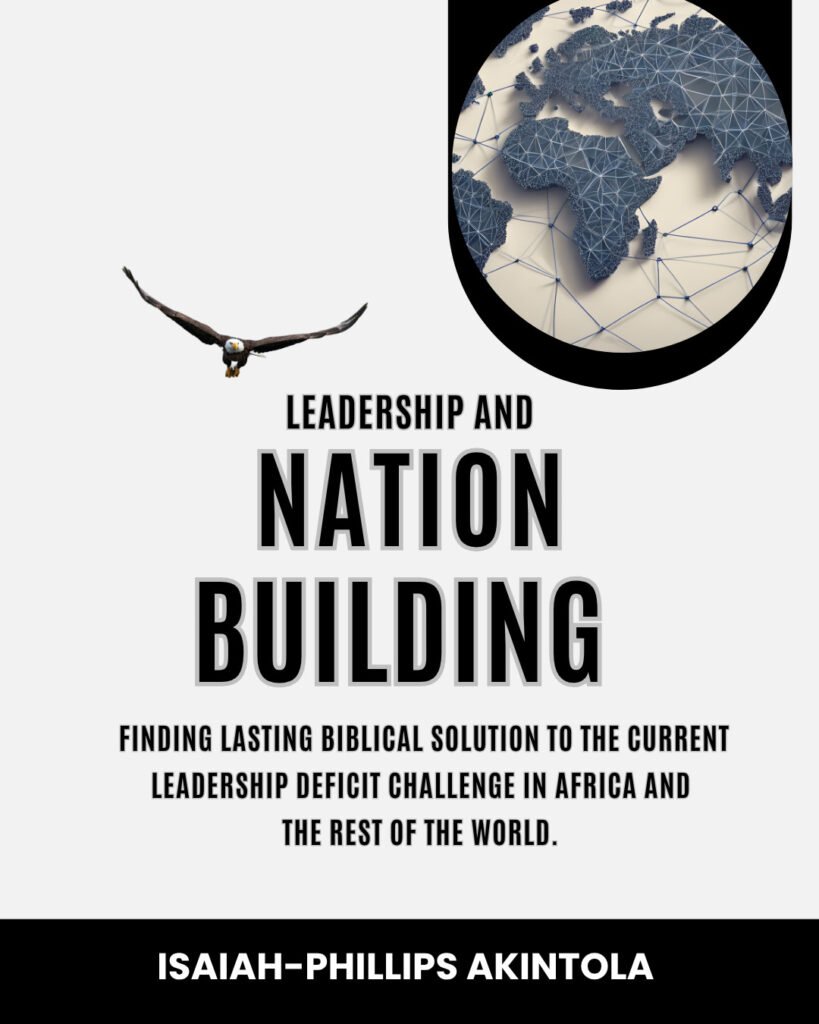
Most of what we observe today, societal fractures, rising Afrophobia and xenophobia, a breakdown of civil trust, and increasing hostility between communities are symptoms of a long-standing leadership deficit that has remained unaddressed. South Africa exemplifies this reality in clear and evident ways. However, similar disintegration can be seen in the United States, various regions of Europe, and across the African continent. Geography does not alter the truth of what is happening before us.
Typically, societies do not face collapse due to external influences; instead, they weaken from the inside, primarily at the level of compromised leadership. When leaders fail to accurately assess the current situation and cannot identify the underlying causes of social unrest, they often resort to ineffective management rather than implementing genuine reforms that lead to transformation. This approach merely addresses the symptoms, leaving the core issues unresolved. Consequently, a cycle emerges, where the same crisis reappears under a new guise, bearing the same burden and inflicting the same damage.
The prophetic word of Hosea still holds: “My people are destroyed for lack of knowledge” (Hosea 4:6). The knowledge the text speaks of is not merely doctrinal; it is diagnostic. The kind of knowledge that can read the state and condition of a nation, identify its condition, and prescribe the correct course of action. Without that, the people perish, not all at once, but gradually, cyclically, until the pattern becomes accepted as normal.
Every Season Demands a New Competence
There is a dangerous assumption embedded in how we approach leadership, the idea that what worked before will work again. The leadership that dismantled colonial structures served its season. The courage that fuelled liberation movements was genuine and could be God-ordained. The men and women who fought apartheid, who marched against slavery, who stood in the gap when entire peoples were being erased, carried something irreplaceable. But their tools, values, and principles of those victories were shaped for their moment. A new season does not inherit the same old toolkit of leadership.
Scripture traces this consistently. Joshua was not Moses. David was not Saul. Elisha carried a double portion, but he carried it differently from Elijah, because the nation he was serving had moved into a different chapter. God does not clone leaders across eras; He raises them specific to the demand of the hour. The shape of the leader is always a response to the shape of the problem.
The world has entered a new season. The social, technological, economic, and spiritual architecture of human civilization has shifted. Old frameworks of national identity are straining under the weight of migration, globalisation, and digital interconnectedness. Communities that once held together through shared geography and shared history are now negotiating entirely new questions about who belongs and who leads. The xenophobia erupting in South Africa, the nativist tensions rising across the West, are not isolated reactions. They are the friction produced when people feel disoriented and the leadership above them has no language for what they’re experiencing.
The Formation That Precedes the Function
Moses is the most instructive case study here. He was educated in the courts of Pharaoh, trained in the administrative and military systems of the most powerful empire on earth. By every visible measure, he was prepared. He had proximity to power, knowledge of systems, and a heart that already ached for his people. Yet when he acted out of that preparation, he killed a man and buried the body in sand. That was not leadership, That was in fact, gifting without formation and transformation.
God then took Moses to the wilderness for forty years. Forty years is not a delay; it is a design. The wilderness does not teach a man how to manage. It teaches him how to hear. It strips away the confidence that comes from position and replaces it with the dependence that comes from encounter. Moses came out of Egypt knowing how empires function. He came out of the wilderness knowing the God who overturns them. The burning bush was not the beginning of his calling; it was the graduation of his formation.
The same principle governs leadership today. Every genuine nation builder carries a period of formation that looks, to the outside eye, like obscurity or failure. Joseph endured the pit and the prison before he walked into the palace. David spent years in caves and wilderness terrain before he sat on a throne. The formation is not incidental to the function; it is what makes the function sustainable. Leaders who bypass that process arrive with ability but without the character to hold what they carry.
What Nation Builders Are Made of
A nation builder is not simply a person with a large platform or a governing title. The title is the smallest part of the equation. What makes a nation builder is the capacity to carry a people through transition, specifically through the kind of transition that dismantles what was familiar and requires the construction of something that has no precedent in recent memory. That is the work. And very few people are willing to pay the price it demands.
Nation builders are diagnostic before they’re directive. They can read a room, read a nation, and read a generation, not through polling data or focus groups, but through a depth of discernment developed in God’s presence. Isaiah 22:22 speaks of the key of the house of David, the authority to open what no one can shut and shut what no one can open. That kind of authority does not come through appointment alone. It comes through intimacy with the One who holds all keys.
Nation builders also carry a specific kind of love that is not sentimental. They do not lead from the need to be liked. They lead from a settled conviction about where the people need to go and an unshakeable willingness to absorb the cost of getting them there. Nehemiah rebuilt a wall with a tool in one hand and a weapon in the other. That is the posture. Constructive and combative, building and defending simultaneously, because real nation building always has opposition, and the opposition is always organized.
Leadership for the Season Ahead
Africa in particular stands at a threshold that requires leaders who are not defined by colonial frameworks on one side or reactionary nationalism on the other. Both have been tried. Both have produced their share of wreckage. What the continent needs, what South Africa needs, what the nations in fracture across every hemisphere need, is a leadership that draws from a higher order of wisdom, one rooted in the kingdom of God and expressed through the specific cultural and geographic context of the people it serves.
Micah 6:8 remains the most concise job description ever written for a leader: “to act justly, to love mercy, and to walk humbly with your God.” Justice without mercy produces hardness. Mercy without justice produces disorder. Humility before God is what keeps both in alignment. A leader who walks in that combination can navigate complexity that would break a leader operating from pride or fear. Those three qualities are not personality traits; they are kingdom competencies that have to be cultivated through consecration and tested through fire.
The new season will not bend to old methods. The fractures we see in society are not going to be healed by more conferences, more policy papers, or more elections alone. They require a generation of men and women who have been genuinely formed, who know who they are before God, who understand the times the way the sons of Issachar understood them (1 Chronicles 12:32), and who carry the moral authority that comes not from self-promotion but from faithful stewardship in obscurity.
God has not abandoned the nations. He is raising nation builders. The question is whether those being raised will submit to the process, endure the formation, and step into their moment with the clarity and conviction the hour demands. History does not remember those who were merely capable. It remembers those who were willing.